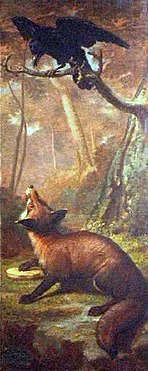
I have many ideas about activities I want my class to do when I become a teacher, but one I have had since I was a freshman in college was to use this fable and the song based on this fable as a puppet show. The original story is one of the lesser known fables written by Aesop.
Like most traditional literature the story has a simple setting known as 'the town', and only three characters the fox, the crow, and the baker. It teaches the lesson that you should not be too prideful. The fox follows the baker around every day trying to get some food, and while the baker is yelling at him the crow flies down from a tree and takes some food. The fox finds the crow and asks her to share, but the crow refuses. So the fox asks the crow to sing to him, because her beautiful voice will make the fox feel better. The bird is easily flattered and starts to sing which causes her to drop the food and allows the fox to take it and run.
The reason I know the story is because of this:
It's one of my favorite songs. As I said before I really want to use it as a puppet show. Here's how I would do that. The last verse would be cut, because it does not actually tell the story. Also, some of the larger words would need to be replaced with synonyms; such as dive down for condescend. Well, that's my take on this story. Let's see what my partner Glyna thinks about it.
-Phillip
I believe that this tale by Aesop falls under the heading of a traditional story. Furthermore, this traditional story can be considered a fable. Here are some of the reasons I believe it is so. Stories qualify as fables when they illustrate a moral lesson. The story uses animals with human characteristics to demonstrate a moral lesson for the readers. The tale ends with a succinct, "Do not trust flatterers."
Fables often contain talking animals and objects. This story has talking animals. "That's for me, as I am a fox," states the fox aloud in the tale.
The characters in traditional stories often represent stereotypes For example, the fox is sly while the crow is foolish. The motif of trickery is present in the story. The fox, through flattery, is able to outwit the crow and steal a treat.
"Good day, Mistress Crow," he cried. "How well you are looking today: how glossy your feathers; how bright your eye. I feel sure your voice must surpass that of other birds, just as your figure does; let me hear but one song from you that I may greet you as the Queen of Birds."
The Crow lifted up her head and began to caw her best, but the moment she opened her mouth the piece of cheese fell to the ground, only to be snapped up by Master Fox.
"That will do," said he. "That was all I wanted. In exchange for your cheese I will give you a piece of advice for the future: "Do not trust flatterers."
The plot of the tale is brief and centers around one main event. The straight forward plot and short tale allow the reader to easily see the moral behind the story. So...the moral behind this blog is that if you ever run into a talking fox be prepared for trickery!

This comment has been removed by the author.
ReplyDeleteYou all pointed out a great point about the plot. Many readers want something easy to follow and to be able to see the moral of it. The moral of this story is fantastic for young students to be amaze by. Many students would be like Wow, a talking fox! It would be great to use in 4th or 5th grade when discussing fables.Lou
ReplyDeleteWhat a great way to combine an activity that you have wanted to do for a long time with a really good blog entry/essay on the characteristics of a fable. I would love to see students act this out in a readers theater setting.--Michaelanne
ReplyDeleteThis store would be a great tale to use for Reader's Theater and I'm sure the students would love to hear the song included in this blog. I have never heard of this story before, but isn't it quite repetitive how the fox is always the source of trickery in lot of traditional literature? I agree with Lou, this story would be a great literature piece to use with 4th-5th graders and the teacher can incorporate critical thinking skills, too. I could visualize the imagery and the personification of the fable at an instant. Great Blog!!
ReplyDeleteI loved that you picked a fable instead of folklore like so many others. Of course, characterization of the animals is very important and we can learn so much from them. Not just trickery from the fox, but we also learn not to get a big head from the crow's response to the flattery. Esther
ReplyDeleteI found it very interesting that you chose a fable unlike others. Combining an activity with this story such as readers theater would be very interactive in a classroom and very enjoyable for students. I have never heard of the fable but would be interested to see what students thought about it and read it for myself.
ReplyDeleteI don't think I have ever heard this story but just by seeing your blog at the beginning it made me want to read it. I loved the video also it really enhanced the blog. This is a great example of traditional literature, it would probably be well enjoyed by highschool students.
ReplyDeleteAshley
I do not think I have ever read this piece of literature, but I do like the idea that you have for when you do use it in the classroom. I think that this would be a great piece of literature to use in your classroom as Reader's Theater and you could allow your students to get in groups to come up with their own plot and setting to the story. Great work! -Mary-Ann
ReplyDeleteThis piece of literature was not one that I was familiar with, but I really enjoyed the blog. I like how each of you shared your thoughts on this tale. I also like how Phillip incorporated the song and explained how he would use it to demonstrate the story through a puppet show. I think that is a great idea. It's great to teach the story to kids in as many different ways as possible.
ReplyDeleteNicole
Even though I have never heard of this fable, y'all did a great job of making me feel like I have read it before. This is a very informative blog that provides good reasons as to why this is considered a fable, and it also provides the motifs that exist within this fable, such as trickery. These are both two elements of traditional literature that can be used to help students understand what traditional literature is about. Colton
ReplyDeleteI don't think I have ever heard of this story before but it seems like a great story. I really enjoyed the video you put up it brought everything together. Excellent job on this!
ReplyDeleteRachel
Using puppets to tell the story would be an excellent way to get the young readers attention. The moral behind the story is also good to teach students. Phillip, you may be right when you say that you may have to replace some of the accommodations of students.- Kayla
ReplyDeleteI have never heard of this story but I love it. It will definetely keep the children entertained by the images of the silly characters. This book definetely uses trickery from the fox and the crow. The fox tricks the crow into singing so he can steal the food from the crow and the crow steals the food from the baker when he is distracted by the fox. It also uses personification when the fox and the crow are talking. I can see myself using this book in my classroom because it seems like it would hold my student's interest.
ReplyDeleteJordan
I have never heard of this story before,but i enjoyed reading about it. Children would love that puppets would be involved when telling the story. I think this would help them stay focused and interested in the story. There are a couple of different elements of traditional literature in this story too. Personification is one. The animals sing, which in real life is impossible. It gives the animals human qualities. There is also a good example of trickery throughout the story.
ReplyDelete-Olivia
I like what you said in the beginning about using this story as a puppet show. I think that would be a great idea and really be of good use to the students. The story is so interesting and I really think that students would respond well to it. -CJ
ReplyDelete