Wednesday, February 27, 2013

Whose legs are these??? Tell me please!!!


The book Legs by Mike Artell is a simple yet entertaining story for younger children that asks the question, "Which animal's legs look like that?" Each page of the story contains a simple rhyme that is unfinished, accompanied by a picture of an animal covered by a flap where the reader can only see the legs.  The flap hides the animal's face and keeps the answer to the poem  concealed. The students can then guess what the answer to the poem is and then lift the flap to reveal the answer. Such as the rhyme, " A girl ran away when I sat down beside her my eight legs are the legs of a..." Let's see if you can get it in the comments.
  
 The rhyming book Legs could be used with the following standard in kindergarten:

ELACCKRF2: Demonstrate understanding of spoken words, syllables, and sounds (phonemes).  a. Recognize and produce rhyming words.

The book could be used to help students become familiar with rhyming words.  Once the students understand the rhyming pattern, they could come up with their own rhyming words with teacher guidance.  

Since Legs is a lift the flap book, the students could make their own simpler version of a lift the flap book using their own rhyming words.  Handouts with pictures of various animals could be given to the students and they could cut out small flaps to cover the head of the animal like the author did in Legs.  This would be another opportunity for the students to come up with more rhyming words to go into the lift the flap book they made.


Thursday, February 21, 2013

Math...Dragons...And Pi!


Sir Cumference and the Dragon of Pi is written by Cindy Neuschwander and illustrated by Wayne Geehan.  The tale will take you on a 'Math Adventure'.  

One day Sir Cumference has a stomach ache after eating lunch.  His son, Radius, goes to the doctor to fetch a cure.  Unfortunately for the father, Radius grabs the wrong thing and turns his father into a fire breathing dragon.  Radius must find a cure to return his father to normal before the dragon is hunted down by the castle guards.  


Back at the doctor's office, the boy finds a curious cure called 'The Circle's Measure' that will turn his father back into the king.  But Radius must figure out the circle's riddle to find the correct dosage or his father will remain a dragon forever!

Radius measures pies, a wheel, and even his father's dragon tail looking for the correct measurement.  He finally figures out the magical potions portions with pi! (3.14)  His father is  changed back into a human and all is well! 

 To celebrate Radius' accomplishment, the King declares that from that day forth any pie with an 'e' will be for eating and pi without an 'e' will be the number for all things round.

An eighth grade class used the story for Reader's Theater.  Here is the link. http://www.youtube.com/watch?v=OU_O8PdDJpI


The book can be used with standards:

 MCC7.G.4: Know the formulas for the area and circumference of a circle and use them to solve problems; give an informal derivation of the relationship between the circumference and area of a circle.

MCC2.G.1:  Recognize and draw shapes having specified attributes, such as a given number of angles or a given number of equal faces. Identify triangles, quadrilaterals, pentagons, hexagons, and cubes.

The story can be used to show that the ratio of the diameter to the circumference of a circle is always pi (3.14). There are tons of activities that a teacher can do with this book. All you need are circle shaped items of various sizes for the children to measure.  Students can prove, just like Radius did in the story, that when measuring the middle of a circle and then using that distance around a circle it always goes around 3 and 1/7 times. Many schools celebrate pi day on March 14 and have the students bring an actual dessert pie from home so they can measure all the different desserts and all get the same results.

This story would be a great way to teach your seventh grade students where pi comes from when learning their equations, and also can be shown to younger students to promote interest in shapes. I'm glad we were able to blog about this book at this time because this is the absolute perfect story for pi day.

Wednesday, February 13, 2013

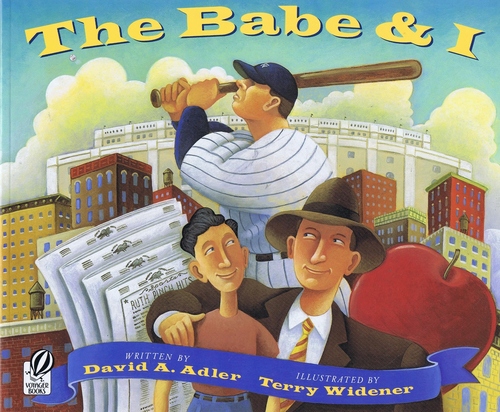
Extra! Extra! Read All About It! The Babe & I


 Want to find out how a newsie meets the great Babe Ruth?  
Then come on and...read all about it!


The Babe & I is a historical fiction book by David Adler.  The story takes place during the Great Depression.  Through the eyes of a young boy, the author shows us life in Brooklyn during this time period.  We see what life was like for those struggling to make ends meet and the inventive ways they accomplished that task.

The unnamed protagonist of the story is a young boy growing up in Brooklyn in 1932 during the Great Depression.  "For my birthday I was hoping my parents would give me a bicycle.  They gave me a dime."  This example from the story shows a young boy's thoughts on his disappointing birthday.

The story develops logically with one event leading to another.  Due to the Great Depression the father loses his job.  The major conflict of the story arises when the boy realizes that his unemployed father is selling apples on the street corner.  The protagonist gets a job selling newspapers near Yankee Stadium to make money and help his father support the family.   This job leads him to eventually sell a newspaper to the great Babe Ruth. 

The elements of the setting are consistent with the time and place of the story.   The author creates a believable 1930's era  Brooklyn.  He paints a picture with his words that the reader can imagine in their minds eye, "everyone was poor...passed a woman selling apples.  Her clothes were wrinkled and shabby."  

Coming of age, specifically the ability to face problems and take responsibility, is the prominent theme.  The protagonist states, "He and I were a team.... His home runs helped me sell newspapers,” states the boy after Babe Ruth buys a newspaper from him outside of Yankee Stadium.   The boy also realizes the responsibility he has to his family.  "I knew Dad and I were also a team. We were both working to get our family through hard times."  

"Give me a high one.  I'm Babe Ruth, the world's greatest baseball player," yells the protagonist best friend. The style is simple with easy to understand dialogue.  "Wow!"  I said.  "I just sold a newspaper to Babe Ruth!" sounds like a realistic reaction of a young boy meeting his hero.

The Babe and I is told from the viewpoint of a young boy.  It is written in first-person narrative form which allows the author to bring the reader right into the life and emotions of the protagonist.

Close your eyes and hear the newsies cry, "Extra! Extra!  Read all about it!"  outside of Yankee Stadium.  Close your eyes and hear the crack of the bat as history is made.