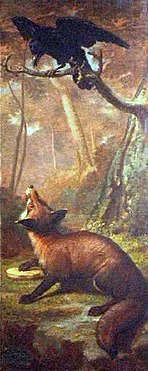
I have many ideas about activities I want my class to do when I become a teacher, but one I have had since I was a freshman in college was to use this fable and the song based on this fable as a puppet show. The original story is one of the lesser known fables written by Aesop.
Like most traditional literature the story has a simple setting known as 'the town', and only three characters the fox, the crow, and the baker. It teaches the lesson that you should not be too prideful. The fox follows the baker around every day trying to get some food, and while the baker is yelling at him the crow flies down from a tree and takes some food. The fox finds the crow and asks her to share, but the crow refuses. So the fox asks the crow to sing to him, because her beautiful voice will make the fox feel better. The bird is easily flattered and starts to sing which causes her to drop the food and allows the fox to take it and run.
The reason I know the story is because of this:
It's one of my favorite songs. As I said before I really want to use it as a puppet show. Here's how I would do that. The last verse would be cut, because it does not actually tell the story. Also, some of the larger words would need to be replaced with synonyms; such as dive down for condescend. Well, that's my take on this story. Let's see what my partner Glyna thinks about it.
-Phillip
I believe that this tale by Aesop falls under the heading of a traditional story. Furthermore, this traditional story can be considered a fable. Here are some of the reasons I believe it is so. Stories qualify as fables when they illustrate a moral lesson. The story uses animals with human characteristics to demonstrate a moral lesson for the readers. The tale ends with a succinct, "Do not trust flatterers."
Fables often contain talking animals and objects. This story has talking animals. "That's for me, as I am a fox," states the fox aloud in the tale.
The characters in traditional stories often represent stereotypes For example, the fox is sly while the crow is foolish. The motif of trickery is present in the story. The fox, through flattery, is able to outwit the crow and steal a treat.
"Good day, Mistress Crow," he cried. "How well you are looking today: how glossy your feathers; how bright your eye. I feel sure your voice must surpass that of other birds, just as your figure does; let me hear but one song from you that I may greet you as the Queen of Birds."
The Crow lifted up her head and began to caw her best, but the moment she opened her mouth the piece of cheese fell to the ground, only to be snapped up by Master Fox.
"That will do," said he. "That was all I wanted. In exchange for your cheese I will give you a piece of advice for the future: "Do not trust flatterers."
The plot of the tale is brief and centers around one main event. The straight forward plot and short tale allow the reader to easily see the moral behind the story. So...the moral behind this blog is that if you ever run into a talking fox be prepared for trickery!
