Thursday, April 18, 2013

Just the GIST please! You're making me Grumpy!


Mr. Gloomingdale's Downpour by Andrew Conlan is the story of a very grumpy man by the name of Mr. Glommingdale.  Mr. Gloomingdale lives in a very lovely cottage with very lovely plants that always had very lovely days, and he hated it.  He's always in such a grumpy mood that he thought the happy plants and animals were making fun of him by smiling all the time, but they were really just trying to make him happy! One day Mr. Gloomingdale gets a letter in the mail telling him about a wishing well.  He goes and finds the wishing well, and knows exactly what he is going to wish for.  He wishes for there to be no sunshine and cheer around him as long he is in this grumpy mood.  All of a sudden a rain cloud appears and starts following him around. He runs into his house to avoid the rain, but it follows him.  He looks outside and realizes that the only one in the rain is him.  The plants are smiling, the sun is shining, and the animals are playing.  To help stay dry, he had to wear a rain coat and carry an umbrella.  He thought it made him look silly which made him livid!  He soon realized that the he was taking up all the rain, and the sunny days were taking their toll on the plants and animals.  Soon the plants began to wilt and the animals fell over.  This didn't make Mr. Glommingdale happy or grumpy, it made him sad.  He put his umbrella down and looked at the plants.  When he did, rain dripped from his yellow hat, and the plant he was standing over started to get better.  After he saw this he hurried to all the plants and animals and gave them water.  After helping all the plants and animals he realized the rain cloud was gone, and he was not grumpy anymore.  He was happy at his very lovely cottage with very lovely plants that always had very lovely days. 

Summarizing information: Means to tell what's important!

GIST: A summarization strategy.  The group will write a summary in 20 words. 

Explanation:  The GIST of something is the main idea.  Sometimes we don’t need to remember all the details but read just to get the GIST of the material.

Procedure: Draw 20 word sized blanks on the chalkboard.
After reading a short section of text (one-two paragraphs), the students will assist the teacher in writing a 20 word summary to give the gist of what they read.

 With older students, read an additional section of text (one-two paragraphs).  Information from both sections must be incorporated into a new 20 word summary.


Can you do a 20 word Gist of the story from the synopsis above?


Thursday, April 11, 2013

I see...I hear...I feel...I smell...I taste...???


    A Quiet Place by Douglas Wood is a wonderful story to help children use the skills of visualizing and inferring.  The story follows a young boy that finds the city just too noisy and dreams of ways to escape. The boy imagines many different places he could go to find quiet; the desert, a forest, a pond, and a museum to name a few.  The reader becomes an adventurer along with the young boy as he explores different settings in his imagination.  In the end, he realizes that you can always go to a quiet place inside your own mind, "the very best quiet place of all." 

Images from the book include scenes from the boy's imagination as he tries to find quiet:  "You could look in the desert, where Old Man Saguaro reaches for the sky, and far-off thunderheads bloom like sky-flowers over the mesas.  And you can be a Pony Express rider galloping through the Old West."

    When we talk to students about visualizing we could tell them to create a movie in their mind before, during, or after they read a book.   To help students understand how to visualize we could model prompts like, "When I read this, I see... I hear... I feel...I smell...I taste..."   Teachers can use a guided imagery activity to help students create mental images.  The teacher asks the students to close their eyes as a descriptive passage is read.  During the reading, pause to ask students what they see, hear, taste, smell, and feel.  After the story, the students can draw what they imagined.  

   To help students use the skill of inferring, teachers can act out small scenes from the story.  For instance, in A Quiet Place the boy is trying to escape from the loud racket of a city,  "A place to rest your ears from bells ringing and whistles shrieking and grown-ups talking and engines roaring..."  The teacher could place her hands over her ears and close her eyes.  The students could infer what the teacher is dramatizing. The story could be dramatized after it is read aloud to the class.  The students would enjoy creating their own  dramatization after the story.

   Take a moment, close your eyes, and find your quiet place. 


Thursday, April 4, 2013

Everyone Worries!


Ira Sleeps Over by Bernard Waber

Ira is super excited to spend the night away at a friend's house for the first time, but then he realizes he will have to decide if he should take his teddy bear with him.  He always sleeps with his bear.  He decides to leave the bear at home but then finds himself scared and unable to sleep after a ghost story!  Will his friend understand if Ira wants his teddy bear?

Have you ever done something for the first time and found it scary?  Like go to a new school, visit a new place, or try a new sport?

Just like Ira, you could be worried about what others will think of you or be nervous about what will happen.  And, because you have felt worried or nervous before, like Ira you can understand that everyone gets scared or worried sometimes!

Making Connections through text to self:

Think about a time you were worried or scared.  You could think about the first day of school and how you felt to walk into a new classroom with new people.  Take out a sheet of notebook paper and draw a line down the middle.  On the left side of the paper,  write down how Ira felt without his bear.  Then,  on the right side of the paper, write how you felt once when you were scared.

How did you solve your problem?   On the back of the paper write down what you did to feel less scared or worried.  When you are finished writing, share your ideas with your writing partner 

Wednesday, March 27, 2013

A Duck for President???


Duck for President by Doreen Cronin and illustrated by Betsy Lewin

This story follows the tale of Duck who thinks Farmer Brown works him too hard.  Believing it will be easier to run the farm than do his chores, Duck decides to run for head of the farm.  He wins the election but finds running a farm much to difficult.  So, he decides to run for governor and then for president of the United States!  Unfortunately for Duck, each new job is harder than the previous one! Eventually, Duck decides to head back to the farm to his simple chores, after he writes his autobiography of course.  

Here is a five minute video of Duck for President.  It combines music, illustrations, narration, and sound effects.  Take a few minutes to check it out!


Social Studies standards that can be used with this story are:

SS3CG1 The student will explain the importance of the basic principles that provide
the foundation of a republican form of government.

SS5CG1 The student will explain how a citizen’s rights are protected under the
U.S. Constitution.  a. Explain the responsibilities of a citizen.

The story can be used with both social studies standards.  Duck for President describes one of the major principles of a republican government which is the right to vote.

The story also shows that a citizen's right to vote is protected under the constitution even if the person they want to vote for is a duck. It also shows that a citizen should be responsible and try to be informed about their vote, since choosing a duck was probably an ill informed decision. As it turns out, Duck is bad at running a farm and being governor.

Students could hold mock elections with a few students 'running' for office.  All the students could vote for their choice of candidate. This would reinforce the importance of the responsibilities of a citizen.

Wednesday, February 27, 2013

Whose legs are these??? Tell me please!!!


The book Legs by Mike Artell is a simple yet entertaining story for younger children that asks the question, "Which animal's legs look like that?" Each page of the story contains a simple rhyme that is unfinished, accompanied by a picture of an animal covered by a flap where the reader can only see the legs.  The flap hides the animal's face and keeps the answer to the poem  concealed. The students can then guess what the answer to the poem is and then lift the flap to reveal the answer. Such as the rhyme, " A girl ran away when I sat down beside her my eight legs are the legs of a..." Let's see if you can get it in the comments.
  
 The rhyming book Legs could be used with the following standard in kindergarten:

ELACCKRF2: Demonstrate understanding of spoken words, syllables, and sounds (phonemes).  a. Recognize and produce rhyming words.

The book could be used to help students become familiar with rhyming words.  Once the students understand the rhyming pattern, they could come up with their own rhyming words with teacher guidance.  

Since Legs is a lift the flap book, the students could make their own simpler version of a lift the flap book using their own rhyming words.  Handouts with pictures of various animals could be given to the students and they could cut out small flaps to cover the head of the animal like the author did in Legs.  This would be another opportunity for the students to come up with more rhyming words to go into the lift the flap book they made.


Thursday, February 21, 2013

Math...Dragons...And Pi!


Sir Cumference and the Dragon of Pi is written by Cindy Neuschwander and illustrated by Wayne Geehan.  The tale will take you on a 'Math Adventure'.  

One day Sir Cumference has a stomach ache after eating lunch.  His son, Radius, goes to the doctor to fetch a cure.  Unfortunately for the father, Radius grabs the wrong thing and turns his father into a fire breathing dragon.  Radius must find a cure to return his father to normal before the dragon is hunted down by the castle guards.  


Back at the doctor's office, the boy finds a curious cure called 'The Circle's Measure' that will turn his father back into the king.  But Radius must figure out the circle's riddle to find the correct dosage or his father will remain a dragon forever!

Radius measures pies, a wheel, and even his father's dragon tail looking for the correct measurement.  He finally figures out the magical potions portions with pi! (3.14)  His father is  changed back into a human and all is well! 

 To celebrate Radius' accomplishment, the King declares that from that day forth any pie with an 'e' will be for eating and pi without an 'e' will be the number for all things round.

An eighth grade class used the story for Reader's Theater.  Here is the link. http://www.youtube.com/watch?v=OU_O8PdDJpI


The book can be used with standards:

 MCC7.G.4: Know the formulas for the area and circumference of a circle and use them to solve problems; give an informal derivation of the relationship between the circumference and area of a circle.

MCC2.G.1:  Recognize and draw shapes having specified attributes, such as a given number of angles or a given number of equal faces. Identify triangles, quadrilaterals, pentagons, hexagons, and cubes.

The story can be used to show that the ratio of the diameter to the circumference of a circle is always pi (3.14). There are tons of activities that a teacher can do with this book. All you need are circle shaped items of various sizes for the children to measure.  Students can prove, just like Radius did in the story, that when measuring the middle of a circle and then using that distance around a circle it always goes around 3 and 1/7 times. Many schools celebrate pi day on March 14 and have the students bring an actual dessert pie from home so they can measure all the different desserts and all get the same results.

This story would be a great way to teach your seventh grade students where pi comes from when learning their equations, and also can be shown to younger students to promote interest in shapes. I'm glad we were able to blog about this book at this time because this is the absolute perfect story for pi day.

Wednesday, February 13, 2013

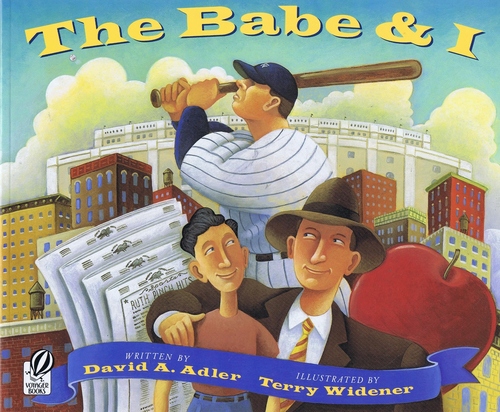
Extra! Extra! Read All About It! The Babe & I


 Want to find out how a newsie meets the great Babe Ruth?  
Then come on and...read all about it!


The Babe & I is a historical fiction book by David Adler.  The story takes place during the Great Depression.  Through the eyes of a young boy, the author shows us life in Brooklyn during this time period.  We see what life was like for those struggling to make ends meet and the inventive ways they accomplished that task.

The unnamed protagonist of the story is a young boy growing up in Brooklyn in 1932 during the Great Depression.  "For my birthday I was hoping my parents would give me a bicycle.  They gave me a dime."  This example from the story shows a young boy's thoughts on his disappointing birthday.

The story develops logically with one event leading to another.  Due to the Great Depression the father loses his job.  The major conflict of the story arises when the boy realizes that his unemployed father is selling apples on the street corner.  The protagonist gets a job selling newspapers near Yankee Stadium to make money and help his father support the family.   This job leads him to eventually sell a newspaper to the great Babe Ruth. 

The elements of the setting are consistent with the time and place of the story.   The author creates a believable 1930's era  Brooklyn.  He paints a picture with his words that the reader can imagine in their minds eye, "everyone was poor...passed a woman selling apples.  Her clothes were wrinkled and shabby."  

Coming of age, specifically the ability to face problems and take responsibility, is the prominent theme.  The protagonist states, "He and I were a team.... His home runs helped me sell newspapers,” states the boy after Babe Ruth buys a newspaper from him outside of Yankee Stadium.   The boy also realizes the responsibility he has to his family.  "I knew Dad and I were also a team. We were both working to get our family through hard times."  

"Give me a high one.  I'm Babe Ruth, the world's greatest baseball player," yells the protagonist best friend. The style is simple with easy to understand dialogue.  "Wow!"  I said.  "I just sold a newspaper to Babe Ruth!" sounds like a realistic reaction of a young boy meeting his hero.

The Babe and I is told from the viewpoint of a young boy.  It is written in first-person narrative form which allows the author to bring the reader right into the life and emotions of the protagonist.

Close your eyes and hear the newsies cry, "Extra! Extra!  Read all about it!"  outside of Yankee Stadium.  Close your eyes and hear the crack of the bat as history is made.